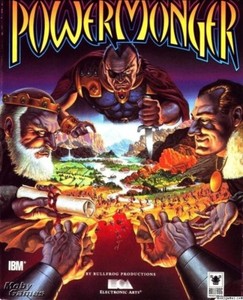
Powermonger Computer Game
Screenshot of the Amiga versionThe game features a game map, although camera movement is limited to rotating the map by 90 degrees or small discrete intervals and 8 pre-defined levels of zoom. Only the map itself is 3-dimensional; people, trees and other game objects are.The game features a fairly advanced (for its time) ' engine. Each person seems to have a mind of their own and will go about his or her job, fishing, farming, shepherding, collecting wood or making items without any input from the player. The player can also use a query tool to view the name, sex, age, allegiance, vital stats, hometown and equipment of any given individual.
This aspect of the game has some clear resemblances (though less advanced) with the later game also designed by.While the player cannot form the land like in, actions can still have some limited effect on the environment. For example, if a large area is deforested, the weather pattern will change and more rain or snow (depending on the season) will fall, making movement slower.The player starts out on each map with a small number of soldiers, and maybe a few towns already under control. To win the map, the balance of power needs to be tipped completely to the player's side (represented by a scale below the mini-map), by conquering all (or at least most) of the towns on the map and killing any opposing captains. Once a town is under the player's control, locals can be drafted into the player's army and bigger towns or enemy armies can be taken on. Some of the bigger towns also have neutral captains and if these survive the battle they come under the player's command as well.The player can only control as many armies as captains, so it is important to keep them alive. If a captain is killed, his army is disbanded and his surviving soldiers go back to their town of origin. Unlike the player's main army – which the main character commands – the subordinate captains have a 'lag' time (indicated by a tiny animation next to their command icon) before their commands are executed.
Mar 15, 2016 PowerMonger takes the basic design and concepts of Bullfrog's previous game Populous, and places it in a war context. The game cast the player as a dispossessed warlord plundering his way through 195 territories on the way to world conquest. Several other leaders have the same goal. PowerMonger takes the basic design and concepts of Bullfrog 's previous game Populous, and places it in a war context. The game cast the player as a dispossessed warlord plundering his way through 195 territories on the way to world conquest. Several other leaders have the same goal.
The further away from the player's main character they are, the longer it takes for orders to reach them.Food is the single most important resource in the game. Aside from friendly towns the player can also slaughter wandering sheep, barter food from neutral towns, or kill an enemy captain and pillage his food supply.Aside from manpower and food, towns can also provide equipment. Townspeople will occasionally make items but to speed things up the player can order an army to 'invent' at a friendly town. Depending on nearby resources and what posture the army is set to (passive, neutral or aggressive), men will then go to work collecting resources and make items. As the more useful items can usually only be made in one or two towns on any given map these have great strategic importance.There is no involved with equipment. Once an army is ordered to equip itself from a pile of equipment it is automatically distributed.
If there are bows, swords, and pikes available, soldiers will pick them up in that order. As long as there are soldiers without any weapon in the army no one will pick up more than one weapon. If everyone has something then people with the least valuable weapon will have first pick and so on. The captain carries any excess equipment.
There is no limit to how much a captain can carry, but the more he carries the slower he (and his army) will move.Powermonger: World War I Edition In 1991 an (for computers only) was released that changed the setting from the conquest of a medieval kingdom, to. The gameplay was still essentially the same, but with more ranged weapons and war-machines.Reception The game got 5 out of 5 stars in. In 1991 praised PowerMonger as 'simply superb. A joy to play'. The magazine favorably cited the graphics and realism, but criticized its unusually strict and the need to load a saved game twice to return to the previous state. In a 1993 survey of pre 21st-century strategy games the magazine gave the game three stars out of five.Reviewing the Sega CD version, criticized the graphics, commenting that 'the maps are so that you can barely see what's going on or who's who.
After going through lots of slow strategy, a nice visual payoff of your decisions being executed would've really added to the FunFactor.' However, they gave the game an overall recommendation based on its slow-paced strategy gameplay. Gave it a rave review, applauding the high detail of the simulation, the graphics, the 'subtle' sound, and the enormous length of the campaign. They scored it 6.6 out of 10.It won Computer Gaming World's 1991 Strategy Game of the Year award. The game was ranked the 32nd best game of all time. References.
Lesser, Hartley; Lesser, Patricia; Lesser, Kirk (April 1991). 'The Role of Computers'. Pp. 47–54. Olafson, Peter (April 1991). Retrieved 17 November 2013. Brooks, M. Evan (June 1993).
Retrieved 7 July 2014. 'ProReview: Power Monger'. P. 48.
September 13, 2013. This means war music soundtrack. July 5, 2014. Retrieved April 7, 2015. Ultimate Guitar.
'Review Crew: Power Monger'. Soulcraft boarding. EGM Media, LLC. September 1994. P. 36.
Staff (November 1991). 'Computer Gaming World's 1991 Games of the Year Awards'. Computer Gaming World. Golden Empire Publications, Inc (88): 38–40, 58. Amiga Power magazine issue 0, May 1991External links. at.
With the success of Bullfrog's god-game Populous, fans of the world conquering/building genre eagerly anticipated the release of PowerMonger. Unlike Populous in respect to the player having god-like control over the world and population, PowerMonger puts you into the world as a leader of troops which ironically introduces situations where the player ends up exerting even more power than in Populous. Even if that weren't the case, the realism factor is a little more down to earth and satisfaction of strategically outsmarting and outgunning the opposition is very rewarding.
The game world is vast but it is only accessible in small increments. Basically, PowerMonger is played a little bit at a time as you work your way through 195 unrelated plots of land to conquer. In amplification, it should be noted that the lands are unrelated in the respect that what you accomplish in one land has no affect on the next one; the only connection is that once victorious in any land, you are limited to advancing only to land that is adjacent to the one just vanquished. In this manner, you work your way through the 195 lands to the ultimate goal of total conquest. While Populous was limited to interaction with the terrain and population as a manipulative means to an end, PowerMonger presents a much earthier grass-roots involvement in which you deal with a living world where sheep can be slaughtered for food, the seasons change, troops are recruited and even carrier pigeons function as a communications device. Even better, there is a definite need for a strategic approach (many is the time your troops will be outnumbered) to the major activity, namely wiping the enemy troops off the map. Only when totally in control (not necessarily by exterminating every enemy) of a land, can you move on. It's this interaction with enemy troops while maintaining your own through use of a simple phalanx of commands (e.g., move, get food, invent, trade, spy, attack and more) that makes PowerMonger so endearing.
The interface is easy (on-screen information can be had at the right click of a mouse button) and intuitive and the 'look' of the game is extremely pleasant. The sense of frenetic and daunting out-of-control activity is not foremost as in Populous but the player involvement is nonetheless total and fascinating in PowerMonger. Relevant to the commands available to the player is the added strategic choice of demeanor (aggressive, neutral or passive) when giving orders and surprisingly this can be a major factor in the outcome of any encounter. Exploring, recruiting, sustenance, invention, weapons supply, battle and many more factors are at the core of the game's enjoyment but the varied elements of strategy and execution of your plans are the highlights in this delightful game. The few flaws in the game are minor and the positive points far outweigh them anyway. An option to delegate orders, the game's marvelous use of terrain, and the smooth interface add to the quality of PowerMonger as an entertaining product.
Graphics: Clear, funny and detailed. Nice presentation.

Sound: Complement game play nicely.
Enjoyment: If you like strategy and control of miniature armies, PowerMonger delivers. The sense of involvement grows as does the difficulty and complexity of the lands as you advance through them.
Replay Value: Even if you finish all 195 lands, there is still plenty of ground to cover by going back and using different techniques and strategies.
Powermonger takes the basic design and concepts of Bullfrog's previous game Populous, and places it in a war context. The game cast the player as a dispossessed warlord plundering his way through 195 territories on the way to world conquest. Several other leaders have the same goal.
The gameworld is now made up of polygons, so the view can be rotated and moved with greater freedom than Populous. Trade, diplomacy, inventions, and scorched earth invasions all play a key role in how the player progressed through the game. Two-player games via modem links are available on computer versions.
How to run this game on modern Windows PC?
People who downloaded Powermonger have also downloaded:
Populous 2, Populous, Populous: The Beginning, Realms, Railroad Tycoon Deluxe, Pirates! Gold for Windows, Sid Meier's Alpha Centauri, Panzer General