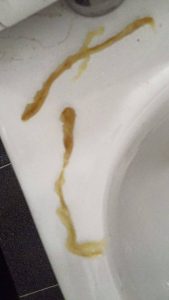
Worms In Human Stool
Signs & Symptoms of Parasites in Stool Pain and Swelling. Parasites within your dietary tract often present as pain within your abdominal. Upset Stomach. Any extended, noticeable upset in your stomach can point to the existence. Visual Examination. An at-home visual examination of your stool.
. Ekanem AP, Brisibe EA. Effects of ethanol extract of Artemisia annua L. Against monogenean parasites of Heterobranchus longifilis. Parasitol Res. 2010 Apr;106(5):1135-9. Grzybek M, Kukula-Koch W, Strachecka A, et al.
Evaluation of Anthelmintic Activity and Composition of Pumpkin (Cucurbita pepo L.) Seed Extracts—In Vitro and in Vivo Studies. Battino M, ed. International Journal of Molecular Sciences. 2016;17(9):1456. Imanshahidi M, Hosseinzadeh H. Pharmacological and therapeutic effects of Berberis vulgaris and its active constituent, berberine. Phytother Res.
2008 Aug;22(8):999-1012. Mahmoudvand H, Saedi Dezaki E, Sharififar F, Ezatpour B, Jahanbakhsh S, Fasihi Harandi M. Protoscolecidal Effect of Berberis vulgaris Root Extract and Its Main Compound, Berberine in Cystic Echinococcosis. Iran J Parasitol. 2014 Oct-Dec;9(4):503-10. Okeniyi JA, Ogunlesi TA, Oyelami OA, Adeyemi LA. Effectiveness of dried Carica papaya seeds against human intestinal parasitosis: a pilot study.
2007 Mar;10(1):194-6. Rouhani S, Salehi N, Kamalinejad M, Zayeri F. Efficacy of Berberis vulgaris aqueous extract on viability of Echinococcus granulosus protoscolices. Prototype 2 torrent download.
J Invest Surg. 2013 Dec;26(6):347-51.
SymptomsMany people with intestinal tapeworm infection don't have symptoms. If you do have problems from the infection, your symptoms will depend on the type of tapeworm you have and its location. Invasive tapeworm infection symptoms vary depending on where the larvae have migrated. CausesA tapeworm infection starts after ingestion of tapeworm eggs or larvae.Ingestion of eggs. If you eat food or drink water contaminated with feces from a person or animal with tapeworm, you ingest microscopic tapeworm eggs. For example, a pig infected with tapeworm will pass tapeworm eggs in its feces, which gets into the soil.If this same soil comes in contact with a food or water source, it becomes contaminated.
You can then be infected when you eat or drink something from the contaminated source.Once inside your intestines, the eggs develop into larvae. At this stage, the larvae become mobile. If they migrate out of your intestines, they form cysts in other tissues, such as your lungs, central nervous system or liver.Ingestion of larvae cysts in meat or muscle tissue. When an animal has a tapeworm infection, it has tapeworm larvae in its muscle tissue. If you eat raw or undercooked meat from an infected animal, you ingest the larvae, which then develop into adult tapeworms in your intestines.Adult tapeworms can measure more than 80 feet (25 meters) long and can survive as long as 30 years in a host. Some tapeworms attach themselves to the walls of the intestines, where they cause irritation or mild inflammation, while others may pass through to your stool and exit your body.Risk factorsFactors that may put you at greater risk of tapeworm infection include:.
Poor hygiene. Infrequent washing and bathing increases the risk of accidental transfer of contaminated matter to your mouth.
Exposure to livestock. This is especially problematic in areas where human and animal feces are not disposed of properly. Traveling to developing countries. Infection occurs more frequently in areas with poor sanitation practices. Eating raw or undercooked meats. Improper cooking may fail to kill tapeworm eggs and larvae contained in contaminated pork or beef.
Living in endemic areas. In certain parts of the world, exposure to tapeworm eggs is more likely. For instance, your risk of coming into contact with eggs of the pork tapeworm (Taenia solium) is greater in areas of Latin America, China, sub-Saharan Africa or Southeast Asia where free-range pigs may be more common.ComplicationsIntestinal tapeworm infections usually don't cause complications.
If complications do occur, they may include:. Digestive blockage. If tapeworms grow large enough, they can block your appendix, leading to infection (appendicitis); your bile ducts, which carry bile from your liver and gallbladder to your intestine; or your pancreatic duct, which carries digestive fluids from your pancreas to your intestine. Brain and central nervous system impairment. Called neurocysticercosis (noor-o-sis-tih-sur-KOE-sis), this especially dangerous complication of invasive pork tapeworm infection can result in headaches and visual impairment, as well as seizures, meningitis, hydrocephalus or dementia.
Death can occur in severe cases of infection.Organ function disruption. When larvae migrate to the liver, lungs or other organs, they become cysts.
Over time, these cysts grow, sometimes large enough to crowd the functioning parts of the organ or reduce its blood supply. Tapeworm cysts sometimes rupture, releasing more larvae, which can move to other organs and form additional cysts.A ruptured or leaking cyst can cause an allergy-like reaction, with itching, hives, swelling and difficulty breathing. Surgery or organ transplantation may be needed in severe cases.PreventionTo prevent tapeworm infection:. Wash your hands with soap and water before eating or handling food and after using the toilet. When traveling in areas where tapeworm is more common, wash and cook all fruits and vegetables with safe water before eating. If water might not be safe, be sure to boil it for at least a minute and then let it cool off before using it. Eliminate livestock exposure to tapeworm eggs by properly disposing of animal and human feces.
Thoroughly cook meat at temperatures of at least 145 F (63 C) to kill tapeworm eggs or larvae. Freeze meat for as long as seven to 10 days and fish for at least 24 hours in a freezer with a temperature of -31 F (-35C) to kill tapeworm eggs and larvae. Avoid eating raw or undercooked pork, beef and fish. Promptly treat dogs infected with tapeworm. Bennett JE, et al., eds. Tapeworms (Cestodes). In: Mandell, Douglas, and Bennett's Principles and Practice of Infectious Diseases.
Philadelphia, Pa.: Saunders Elsevier; 2015. Accessed Sept. 2, 2017. Ferri FF. Tapeworm infestation. In: Ferri's Clinical Advisor 2018. Philadelphia, Pa.: Elsevier; 2018.
Accessed Sept. 2, 2017.
Leder K, et al. Intestinal tapeworms.
Accessed Sept. 2, 2017. Parkasaurus videogame all dinosaurs games. Goldman L, et al., eds.
In: Goldman-Cecil Medicine. Philadelphia, Pa.: Saunders Elsevier; 2016. Accessed Sept. 2, 2017. Parasites and foodborne illness. Department of Agriculture.
Accessed Sept. 27, 2017. Overview of tapeworm infections. Merck Manual Professional Version. Accessed Sept. 27, 2017.
Diphyllobothrium latum (and other species) FAQs. Centers for Disease Control and Prevention. Accessed Sept.