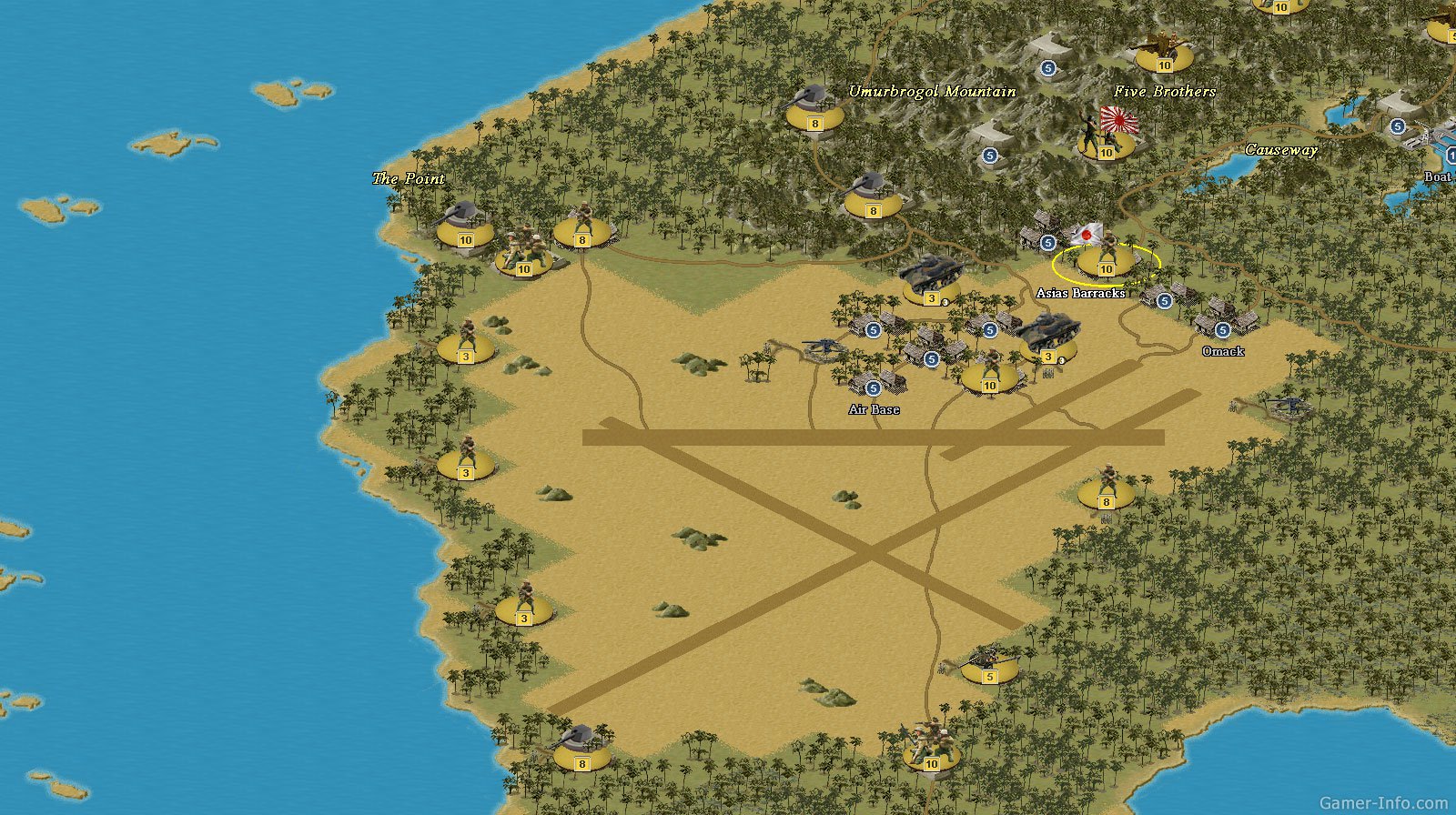
Strategic Command Wwii Pacific Theater Torrent
In cooperation with Buka Entertainment and, cdv Software Entertainment USA today released a new patch for their WWII title,. The new patch, which brings the retail version of the hybrid RTS/strategy/action game to 1.52, includes fixes for various crashes and minor performance issues. For a full list of fixes included in this patch, please visit the game's official North American Web site atThe patch may be downloaded from pacificstormallies.cdvusa.com/ Allies is the latest title in the Pacific Storm series of WWII Pacific theater games which combine real-time strategy, resource management and exciting, in-your-face combat action. In Pacific Storm: Allies, players jump into the thick of battle, playing as the United States, Japan, and a new playable nation - the United Kingdom. Allied nations, including the Netherlands, Germany and Russia, offer a new level of diplomacy and resource management to the game.
Starting in 2002, the Strategic Command series has seen 6 full releases, including this one, that have covered every theater of WWII and the European Theater of WWI. In addition, we’ve also been able to produce a number of expansion packs to fill the void between major releases. However, one item that has never been included. Strategic Command 2: Blitzkrieg is a grand strategy computer game developed by Canadian studio Fury Software, and published by Battlefront.com in 2006. The second game in the Strategic Command series, Blitzkrieg is a turn-based strategy set in World War II, focusing on the European Theater. The player controls all of either Axis or Allied states.
An updated graphics engine brings to life new aircraft, naval ships and landscapes, showcasing them in lush, vivid detail. As with the original Pacific Storm: Allies offers something for everyone - armchair admirals can take command of massive fleets from a sweeping strategic perspective, while the action fan can jump into the cockpit to battle it out in the skies, or man deck guns to turn enemy ships into smoking hulks. About cdv Software Entertainment USA USA, a wholly owned subsidiary of cdv Software Entertainment AG, is a leading publisher of third-party video games and interactive entertainment with offices in New Jersey and headquarters in Cary, North Carolina. Cdv Software Entertainment USA has published critically acclaimed and commercially successful titles including Divine Divinity, Blitzkrieg, American Conquest, Codename: Panzers, City Life, DarkStar One, War Front: Turning Point and the acclaimed Sherlock Holmes: The Awakened. The company will continue to expand its offerings with upcoming titles including the highly anticipated Sacred 2: Fallen Angel.
For more information, please visit https://www.cdvus.com.
Author: Doug McLean
For a long time only one computer game endeavoured to model the entire War in the Pacific, and it was aptly named War in the Pacific. This daunting opus still provides the most detailed game available, but over the recent holidays two newcomers appeared. War Plan Pacific offers the chance to relive the war in an evening ? a ?lite? version of this war. The other newcomer, Strategic Command WW II: Pacific Theater comes from a distinguished European war lineage and seeks to offer a moderately ?lite? but filling overview. Does Strategic Command WW II: Pacific Theater succeed in hitting the sweet spot between two extremes, or does the Pacific war get lost in translation?
Introduction
Strategic Command WW II: Pacific Theater covers the entire Asia-Pacific war from December 1941, Pearl Harbor, to the end of 1945. There is one campaign covering the whole conflict, and another eleven smaller campaigns covering key aspects/battles of the conflict using a reasonably historical approach. The game aims to model an operational/strategic view of the war, though in some ways it also adds tactical aspects. The major campaign map is suitably large, covering 198 tiles from east to west, and 82 from north to south. Each of the squares on the map roughly represents 50 miles, while the alternating turns of the Japanese and Allied players take ten calendar days each.
Strategic Command WW II: Pacific Theater falls neatly between War in the Pacific and War Plan Pacific in terms of detail and scope. Gamers now have real choice in how deep or how abstract they approach the Pacific war. Strategic Command WW II: Pacific Theater, while not nearly as detailed as War in the Pacific, seeks to provide a reasonable idea of the scope and sweep of the vast war that occurred in the Pacific between 1941 and 1945, using a turn-based system. The map, unit, country and events all work well together to provide an appropriately grand impression of the war, and those not familiar with the many different areas involved in this massive conflict will be educated quickly. The war also witnessed the most wide-ranging battles in naval history, recounted in such classic books as The Fast Carriers by Clark Reynolds. Strategic Command WW II: Pacific Theater certainly features carrier battles, but fast or sweeping are not the words that come to mind for them.
The main campaign starts with the infamous Japanese carrier attack on Pearl Harbor.
Carriers are critically important, and much improved in this latest Strategic Command offering.
Presentation
Strategic Command WW II: Pacific Theater can most easily be described as a command perspective game, with the main map screen being the focus of most activity. The map is two dimensional, with generally clear markings and a choice of symbol style counters or 3-D representative icons for units. The graphics are not cutting edge, but eminently serviceable for this type of turn-based game. The map is quite impressive, and highlights salient terrain well. Railroads play an important role in the ground war, and the lack of rail connections in the Burma-Thailand-India area combined with the harsh terrain there quickly forces players to appreciate the difficulties faced by commanders fighting in this rugged area. In the campaign game, the game designers have made some interesting decisions to accommodate the game engine to the geography. In particular, a number of islands are represented at much greater than actual size in order to allow units to be deployed on them. While this makes the map inaccurate, it does result in a compromise that seems to work in a game system where stacking is not allowed. The compromise between physical geography and playability actually works rather well.
The game is not aimed at those seeking the adrenalin rush found in many first person shooters. It is a thinking person?s game, where the emphasis is on forcing players to make difficult strategic choices without overloading them with too much detail. Grognards might not appreciate some of the abstractions, but can probably live with them, while more casual gamers can choose to reduce the complexity a little more if they wish, and still get a reasonably good idea of the kind of challenges military commanders faced in the Pacific. The detached, commander?s perspective to the game means that the violence is rather abstract, as units are reduced in strength or destroyed by attacks. There are explosion sounds, but otherwise the violence is absent. However, the air around my computer screen can still turn blue when a particularly valuable unit, such as a carrier, disappears after an air strike.
Installation and Technical Issues
The one important issue to note here is that Battlefront has adopted a DRM system known as e-license. This seems to work well, but, clearly, the issue is a contentious one for many gamers. The game can be downloaded (as I did for Strategic Command WW II: Pacific Theater) or a physical copy can be ordered (as I did for Patton Drives East at the same time as I ordered Strategic Command WW II: Pacific Theater). Installation in both cases proceeded smoothly, and Battlefront has been generally responsive to those gamers who encounter technical challenges.
Strategic Command WW II: Pacific Theater worked well from the beginning, although there appear to be some minor glitches. I have experienced no crashes to desktop (CTD), and I have great confidence, given the impressive track record of Hubert Cater to date, that patches addressing any problems that have been identified, as well as improvements to game play based on player feedback, will be forthcoming. This is probably as good a place as any to highlight the fact that Hubert Cater has proven to be an extremely responsive game designer, who actively participates in Battlefront forum discussions and clearly does his best to address any and all legitimate issues with his games, including suggestions for game improvement or enhancement.
The Japanese invasion of Malaya is also an important first turn event.
Documentation
Documentation comes in two forms. A printed manual of 89 pages accompanies the CD (if ordered), while a much longer 164 page Adobe manual is found in the installed folder. Broforce beta. The printed manual covers game mechanics and provides an introductory tutorial discussion of the first few turns of the main campaign, some strategy hints and a description of the very extensive game editor features. Aside from the small font and sometimes difficult to read tables, it is a reasonable product. Game mechanics are straightforward enough that I was able to just dive in and click around to learn how things work, but many gamers may find that there will be a lot of trial and error that way. Reading the manual will provide a good understanding of how the game basically works. However, to really understand and master the game requires going through the online manual, as it contains the numerous ?scripts? that govern a wide range of events, from the declaration of war by neutrals to determining victory.
Graphics and Sound
Strategic Command WW II: Pacific Theater has graphics and sound that are functional and generally easy on the senses. The main display used will be the map view. Great effort has clearly been made to produce maps that are reasonably esthetic while also being readable. For the most part, this has been achieved, although there are still places when complex terrain makes distinguishing what is really on the map all but impossible, especially when bad weather ? the ubiquitous monsoon rains in some regions ? is present. In those cases there is a cursor function that allows the properties of any square to be checked, which can come in handy. The icons that can be used for units soon become easy to remember, and I found myself using the icon view almost exclusively. There are also a number of different information panels, either presenting information in tabular or different map forms, and these are both easy to read and very handy.
By doing so, colorless objects become red and regain the essence of time. You will also need to make use of the giant’s super strength by lifting and throwing objects to clear your path.Every stage is a puzzle waiting to be pieced together. About This GameIn A Rose in the Twilight, use Rose’s power to absorb blood and transfer it to static objects. A rose in the twilight ps4. The further you get, the harder it becomes, but the greater the risk, the bigger the reward.
Hong Kong and Manila await the Japanese onslaught.
Sound is also mainly utilitarian. There is an opening musical score that is martial and somewhat oriental, which shuts off ? fortunately ? once the game actually starts. When playing, there are marching or clanking sounds when infantry or tanks move, swishing sounds as ships steam, roaring sounds as planes soar, and explosions as attacks hit home. The sounds are appropriate and add a bit of ambience, but are hardly a critical reason to play.
Interface
During the course of a turn a player decides on units to be moved/involved in attacks, and resources to be expended on R&D, production, and diplomatic actions. Moving units and attacking with them generally absorbs the most attention, and this is why players will spend most of their time in the main map view. Most activities here are reasonably intuitive. Clicking on a unit will result in reachable squares being highlighted. For most units players can either attack and then move, or move and then attack, with aircraft carriers being the important exception. Movement options will be affected by changes in the vicinity of a unit, either as enemy units and the influence they exert are destroyed, or as friendly units move up and change the relative influence in a square.
At the basic unit grab and click level the interface is excellent. The interface also provides quite a bit of information on diplomacy when you access the diplomatic screen, or the losses suffered by you or your opponent?s units. Information on existing forces is very accurate for your own forces, but generally is suspect for your opponent?s forces because of the influence of the fog of war.
There are also a number of ?Decision Events? where the player has to make a yes or no decision. These are quite helpful in getting players into their respective roles, and are sort of a mini-history lesson embedded in the game system. The evolution of the Strategic Command game system has seen the use of Decision Events grow, which is a good thing.
The Japanese player can quickly review his total number of units in this screen.
Fog of war means that Allied totals are very suspect.
However, beneath the surface there is some information that is not always as easy to understand. Player actions or inactions can cause events to occur in the game, but it is not always clear why things are happening or not happening. For example, a Japanese player advancing in China will soon become aware that the more successful he is, the greater the chance he will trigger the entry of another Chinese warlord or the Communist Chinese. While the trend is easy enough to figure out, it is not always clear what specific action triggers the entry of a specific warlord. In one sense this is quite reasonable as the world of that period (as with any period) was hardly completely predictable. So variability or randomness is actually a good way of reflecting the realities of the period. Yet some indication of why things have happened might also be reasonable at times. The many different events triggered as a result of actions taken by the player are intriguing and occasionally frustrating aspects of the Strategic Command WW II: Pacific Theater design system.
Comments
Log in to join the discussion.